

Payout: EUR → KES
A European payout company pays a beneficiary in Nairobi. Its customer balance already sits on the Stellar hub as USDC.
This is the shape pnpm stellar:payout runs on testnet: the route, the saga, the Stellar payment and every ledger entry are the real ones; the anchor is MockPartner, because no anchor is signed, so no Kenyan shilling actually moves.
The plan
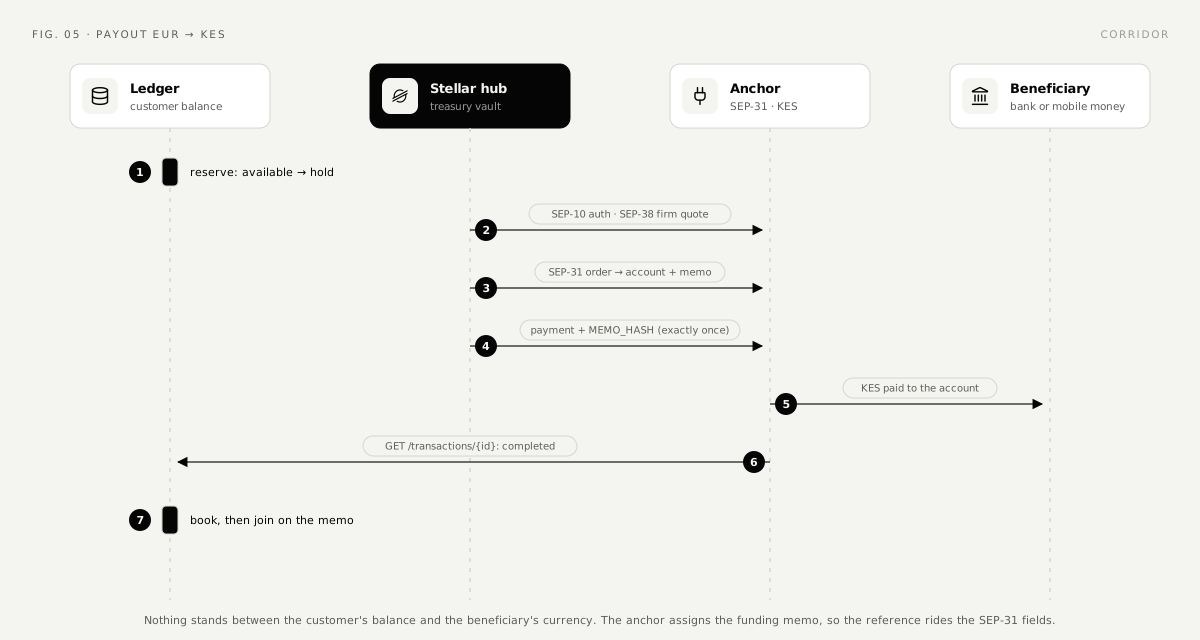
Section titled “The plan”ledger.reserve → partner.payoutThat is the whole route, on testnet and on mainnet. The anchor settles on the hub, so nothing stands between the customer’s balance and the beneficiary’s currency — no bridge, no second chain, no intermediate vault.
Step by step
Section titled “Step by step”Reserve
The amount moves from the customer’s available balance into a hold, so it cannot be spent twice while the payout is in flight.
| Account | Debit | Credit |
|---|---|---|
liability:customer:eu-payco:EUR-KES:USDC:stellar |
7 USDC | |
liability:customer_hold:eu-payco:EUR-KES:USDC:stellar |
7 USDC |
Both accounts are no_overdraft, so a payout larger than the balance is refused inside the same database transaction.
Authenticate and quote
SepAnchor fetches the anchor’s stellar.toml, gets a SEP-10 challenge, verifies it (built by the anchor’s own SIGNING_KEY, naming this vault, on the expected network) and only then signs it. The JWT is cached.
SEP-38 then gives a firm quote: sell stellar:USDC:<issuer>, buy iso4217:KES, context: "sep31". The beneficiary amount is known before anything moves.
Open the order
POST /transactions with the quote, the beneficiary fields and the Corridor Reference in fields.transaction.reference. The anchor returns stellar_account_id and its own stellar_memo. The order link is recorded before anything is sent.
Fund it, exactly once
A Stellar payment from the treasury vault to the anchor’s receiving account, carrying the anchor’s memo — on this leg Corridor’s reference cannot ride in MEMO_HASH, so it travels in the SEP-31 fields and the join key is (anchor, transaction id).
Before sending, the leg asks Horizon whether an identical movement already landed, so a retry after a crash finds the payment instead of sending it again. The funding transaction is then recorded durably.
Wait
SEP-31 has no webhook, so the saga polls GET /transactions/{id} until the anchor reports completed. The anchor pays KES to the beneficiary’s account or mobile wallet on its own rail.
Book it
| Account | Debit | Credit |
|---|---|---|
liability:customer_hold:eu-payco:EUR-KES:USDC:stellar |
7 USDC | |
asset:vault:treasury:USDC:stellar |
7 USDC |
Keyed on partner_fiat / ${anchor}:${orderId}, so it can only be booked once. Anchor rounding is booked as dust held for the customer rather than written off.
Reconcile
The Stellar payment is an Observation from Horizon; the completed order is an Observation from the anchor. Both match the ledger entries keyed by them, and checkInvariants() confirms every entry balances per asset.
Net effect
Section titled “Net effect”| Account | Change |
|---|---|
| Customer available balance | −7 USDC |
| Customer hold | 0 |
| Treasury vault on Stellar | −7 USDC |
expense:gas |
+ the XLM fee the transaction paid, booked from the transaction |
| Beneficiary | + KES at the quoted rate |
If it fails
Section titled “If it fails”- Before funding: the saga compensates in reverse order. The hold is released and the customer ends exactly where they started. See Failure and compensation.
- After funding: the saga stops at
manual_review. The money is at the anchor until its refund is confirmed, and unwinding Corridor’s books before that would describe a sequence that never happened.
Funded in something other than USDC
Section titled “Funded in something other than USDC”A balance in EURC or MGUSD plans as reserve → stellar.pathPayment → partner.payout, converting on Stellar’s own order books. The planner produces that route; the path-payment leg is not written yet.
What has actually run
Section titled “What has actually run”| Run | Result | Transaction |
|---|---|---|
pnpm stellar:payout, 17 Oct 2026 |
Route planned, balance reserved, order opened and funded exactly once with a real Stellar payment, every movement booked, no invariant violations | ac025984… |
The run moves XLM, because a funded testnet USDC trustline needs an issuer faucet, and the anchor is a mock. A signed anchor replaces the mock with SepAnchor and supplies its own funding address and memo; nothing else changes.