

Hub and spoke
Two primitives
Section titled “Two primitives”Every flow on Corridor is one of two things:
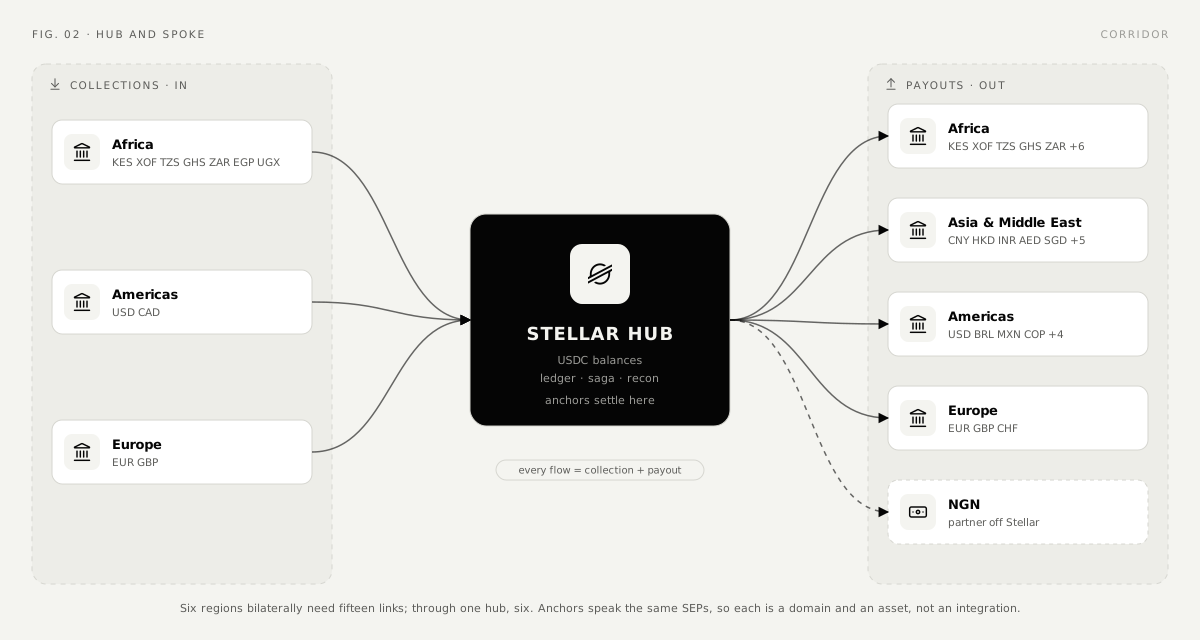
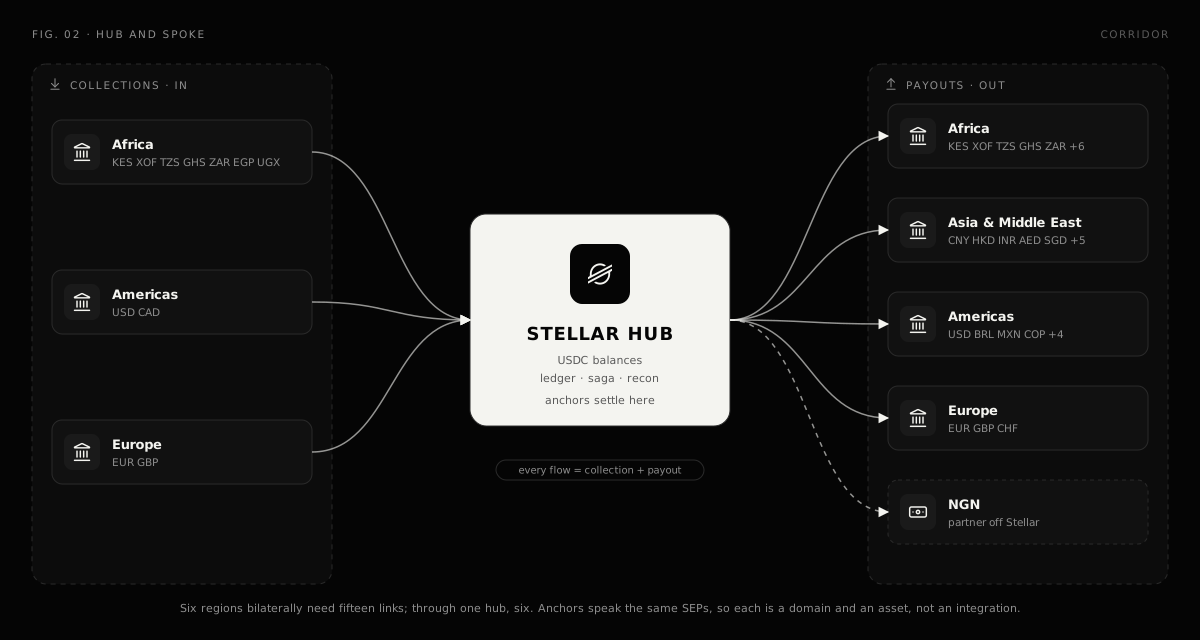
- Collection: local currency comes in through an anchor and is credited to the customer’s USDC balance on the hub.
- Payout: the customer’s balance on Stellar goes out to a spoke, where an anchor pays local currency.
A cross-border payment is a collection followed by a payout. The customer’s balance on the hub sits between them, so the two halves can happen at different times, in different amounts, and through different anchors.
Why a hub, and why this one
Section titled “Why a hub, and why this one”A bilateral network of six regions needs fifteen links. A hub needs six. Every anchor added reaches every customer and every other region on day one.
Anchors speak the same SEPs, so adding one is a home domain and an asset rather than an integration. A corridor is just a currency pair: GHS-HKD works the moment a GHS collector and an HKD payer exist.
A Stellar anchor settles on the hub itself. The fiat spoke touches the hub directly, so the usual payout is ledger.reserve → partner.payout with nothing in between.
Customers keep one balance instead of a float in each country, and every movement is settled, held and reconciled in one ledger.
The hub is enforced
Section titled “The hub is enforced”The planner refuses flows that bypass the hub. This is a correctness property, tested in routing.test.ts, not a convention:
if (purpose === "payout" && !onHub(req.source)) throw new NoRouteError("payouts are funded from the customer's balance on the Stellar hub");if (purpose === "collection" && !onHub(req.destination)) throw new NoRouteError("collections settle into the Stellar hub");See ADR 0002.
Priority flows
Section titled “Priority flows”| Flow | Direction | Example | Payout rail |
|---|---|---|---|
| Diaspora and B2B payouts into Africa | Inbound | EUR/GBP/USD → KES, XOF, TZS | Anchor’s local bank or mobile money rail |
| Import payments to China and Hong Kong | Outbound | KES/GHS → CNY, HKD, USD | Supplier’s Hong Kong or offshore USD/HKD account (onshore CNY conversion is restricted) |
| Import payments to India, UAE, Turkey, SE Asia | Outbound | KES → INR, AED, TRY, IDR | Local anchors |
| Payments to the Americas | Outbound | KES → USD, BRL, MXN | ACH/wire, Pix, SPEI |
| Intra-African trade | Both | KES ↔ GHS, XOF, TZS | Local anchors |
Corridors open in this order: KES, XOF and TZS first, then NGN through a licensed partner, then Ghana and South Africa. None of these anchors is signed yet.
The naira exception
Section titled “The naira exception”No licensed naira anchor is live on Stellar, so NGN sits in OFF_STELLAR_PAYOUT_CURRENCIES and routes over one CCTP hop to a partner that settles on Solana:
ledger.reserve → cctp.transfer (Stellar → Solana) → partner.payoutWhen a Stellar naira anchor exists, removing NGN from that list moves the corridor onto the hub. The cctp.transfer leg itself is not built; on testnet, bridge.simulated stands in for it with the same bookings and a real Stellar leg.
Regulation of outbound flows
Section titled “Regulation of outbound flows”Outbound FX from markets such as Nigeria is regulated: import payments need a Form M and must go through institutions licensed for FX. Corridor stays infrastructure. The licensed PSP or IMTO holds the FX permissions and the KYC; Corridor carries the compliance references (invoice number, Form M number) in the saga data and produces the reconciliation trail as audit evidence.