

Corridor
Corridor is the payment ledger and router that licensed payment companies run in their own environment, on their own keys. It runs cross-border stablecoin payouts across the anchors and providers a company already uses, exactly once, and keeps one set of books that matches the chain, from the customer’s funding to the beneficiary’s bank credit.
Stellar is the settlement hub. Corridor doesn’t hold money, provide liquidity or carry licences — anchors and licensed operators do that, and Corridor runs payouts across them.
What runs today
Section titled “What runs today”A payout runs end to end on Stellar testnet: the route planner picks the legs, the saga engine funds the anchor order exactly once, and the double-entry ledger closes with no invariant violations.
One reference, carried whole in Stellar’s MEMO_HASH, which is exactly 32 bytes.
The ledger keeps Stellar’s own precision, so a booked balance can equal an on-chain balance exactly.
298 testsOver the venue, the planner, the ledger, the saga engine and the SEP anchor adapter.
0 keysCustomer keys Corridor holds. Every vault signs through the customer’s own signer.
Reproduce it with pnpm stellar:wallets && pnpm stellar:smoke, then pnpm stellar:payout for the whole saga. Both runs are on the Evidence page with their transactions.
Who it’s for
Section titled “Who it’s for”Licensed remittance operators, payout companies, PSPs and business-FX firms that send stablecoin payouts through two or more anchors or providers. That is where payouts stall halfway, retries pay twice and fees go unexplained. A company with one provider on one chain is well served by that provider’s dashboard; Corridor is for the companies that have outgrown it.
How it works
Section titled “How it works”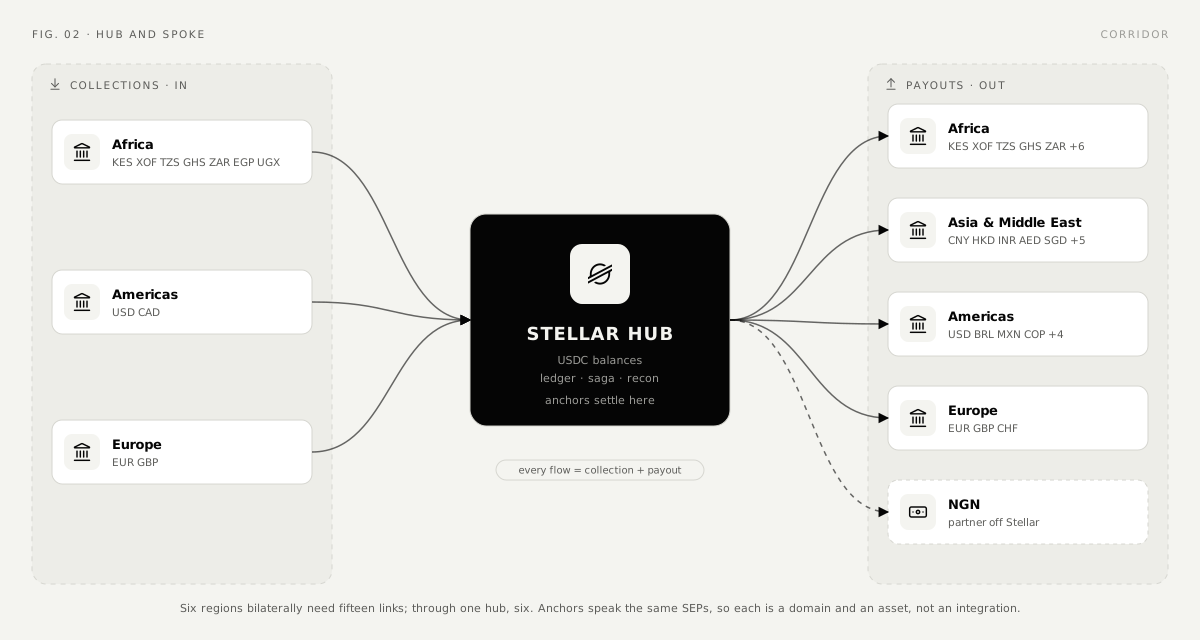
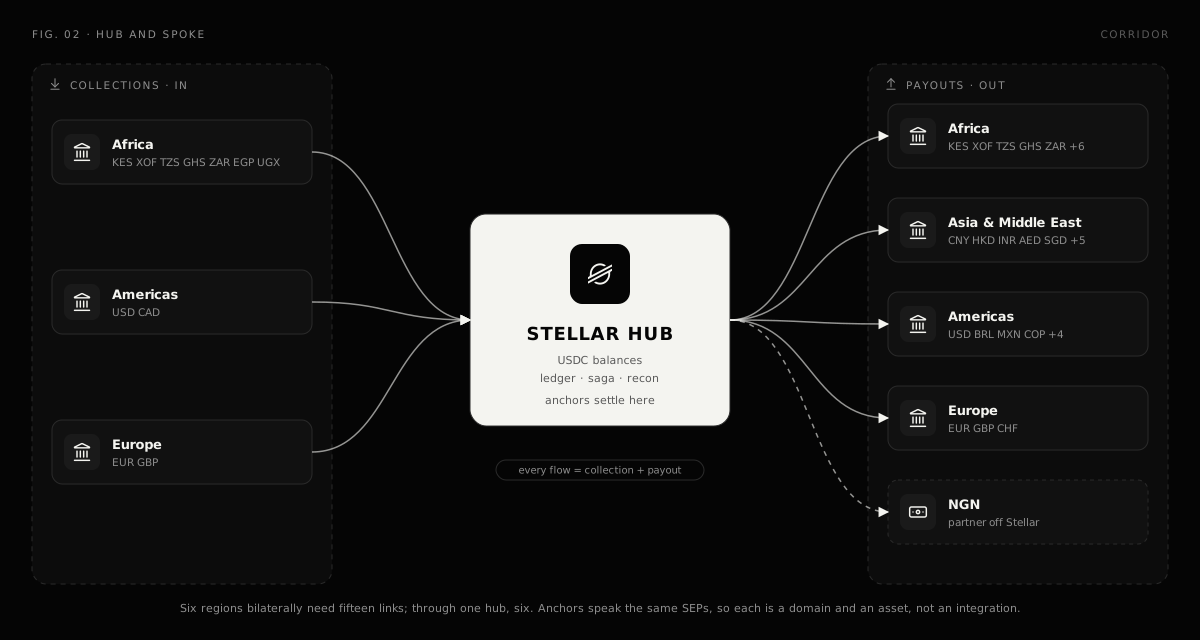
Every flow is either a collection into the Stellar hub or a payout out of it. A diaspora transfer into Nairobi is a euro collection followed by a shilling payout; a Nigerian importer paying a supplier in Shenzhen is a naira collection followed by a yuan payout.
Because anchors settle on Stellar itself, the common payout path has no bridge in it at all, and because every anchor speaks the same SEPs, adding a corridor is a domain and an asset rather than an integration: N integrations instead of N×N corridors.
Each payout is a durable saga. Every external step is recorded before Corridor waits on it, every movement is booked from the transaction that caused it, and the same 32-byte reference rides every leg.
Explore
Section titled “Explore”For a Stellar reviewer: what to read, in order, to judge the work — and what to run.
What Corridor isThe product, who it serves, and the state of every capability.
Read-only pilotHow a payment company starts: watch the Stellar accounts it already runs and match its own payout records.
ArchitectureLedger, route planner, saga engine and reconciliation: one engine per concern.
Anchors as spokesSEP-1, 10, 12, 38 and 31 behind one partner interface.
The opportunity$31.6T of cross-border B2B payments, under 1% on stablecoins so far, and how Corridor earns on it.
EvidenceEvery transaction behind these claims, linked to its explorer.
DecisionsTwelve records: the context, the decision, the consequences, the alternatives rejected.